
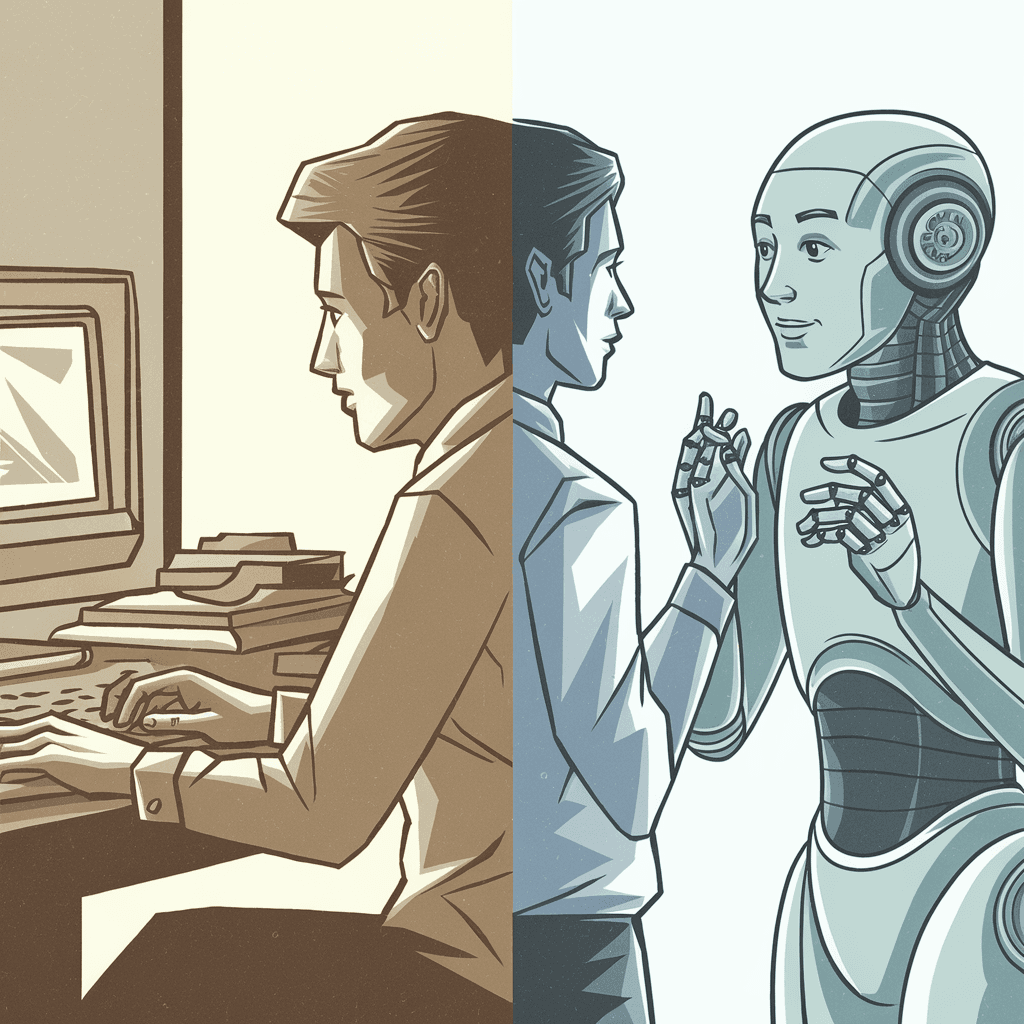
The IDE is a dead man walking. Not because AI will replace programmers—that's a lazy take. The IDE is dying because it solves the wrong problem.
IDEs exist to lower the cognitive load of working with large codebases. Jump to definition. Find all references. View type hierarchy. Flyout documentation. These affordances exist because human brains can't hold an entire codebase in working memory. So the IDE does it for you. It maintains a graph of symbols and references, and you navigate that graph with keyboard shortcuts.
This was revolutionary in the 1990s. It's becoming irrelevant now.
The graph in your head
Here's what an IDE actually does: it keeps a reference graph in memory so you don't have to. When you hit F12 to jump to definition, you're querying that graph. When you hover over a function to see its signature, you're querying that graph. The entire value proposition of an IDE is that it remembers things so you can forget them.
But AI coding assistants already have the graph. They've ingested your entire codebase. They understand the relationships between modules, the inheritance hierarchies, the call chains. And unlike an IDE, they can answer questions about that graph in natural language.
"Where is this interface implemented?" is a query you used to need an IDE for. Now you just ask. The IDE's value as a navigation tool is collapsing.
Boilerplate is dead
The other thing IDEs do is generate boilerplate. Stub out an interface implementation. Generate a unit test. Create getters and setters. Scaffold a new class from a template.
This was useful when writing code was the bottleneck. But AI agents generate code better than any template engine. They understand context. They can infer intent. They don't just fill in blanks—they reason about what you're trying to accomplish.
If you're still using IDE wizards to generate code, you're leaving leverage on the table. The boilerplate generation feature of your IDE is already obsolete. You just haven't noticed yet.
The keyboard is the wrong bottleneck
Here's the real issue: IDEs optimize for the wrong phase of software delivery.
Think about the entire software development lifecycle. You have ideation, requirements, architecture, design, implementation, testing, deployment, monitoring, iteration. The IDE only helps with one of these: implementation. The keyboard work. The part where fingers hit keys and code appears on screen.
But implementation is increasingly the cheapest part of the process. AI has driven the marginal cost of producing code toward zero. What used to take a day now takes an hour. What used to take a week now takes a day.
Meanwhile, the expensive parts of the SDLC remain stubbornly expensive. Getting requirements right. Making good architectural decisions. Sorting and batching work effectively. Ensuring the long chain of internal deliverables are high quality before coding even begins. These are the bottlenecks now. And IDEs don't help with any of them.
It's like optimizing the speed of your assembly line while ignoring the fact that you're building the wrong product. The production line isn't your constraint. The design process is.
From development to delivery
The IDE metaphor is Integrated Development Environment. Development. As if the environment only needs to integrate the coding part.
The future metaphor is Integrated Delivery Environment. An agentic platform that spans the entire lifecycle. From ideation to launch to iteration. Soup to nuts.
We're already seeing this emerge. Spec-driven development environments are pushing the tooling boundary upstream into business requirements. The spec becomes a first-class artifact that the environment understands and tracks. It's not a plugin. It's not an afterthought. It's the foundation.
This is a fundamental shift. Traditional IDEs treat requirements as something that exists outside the tool. You write specs in Confluence or Notion or whatever, and then you context-switch into your IDE to implement them. The IDE has no idea what you're building or why. It just knows about code.
Integrated delivery environments collapse this gap. The requirements, the architecture decisions, the implementation, the tests, the deployment—they're all part of the same system. The AI understands the full context because the full context lives in the environment.
What this means for you
If you're a developer who has spent years mastering IDE shortcuts, this might feel threatening. Your competitive advantage is eroding.
But here's the thing: the skills that matter in an integrated delivery environment are the skills that always mattered. Understanding the problem domain. Making good tradeoffs. Communicating clearly. Thinking in systems.
The IDE made keyboard proficiency valuable. The integrated delivery environment makes thinking proficiency valuable. That's a better world for developers who are more than just typists.
The IDE isn't dead yet. But it's on life support. The companies building the future of developer tools aren't building better IDEs. They're building environments that understand the entire delivery process, not just the typing part.
The question isn't whether this transition will happen. It's whether you'll be ahead of it or behind it.
I'd love to hear how you're thinking about this shift. Join the Vibe Academy community where developers are discussing the future of AI-powered development. [Join the conversation →](https://www.vibe.academy/vibe-academy-community)