
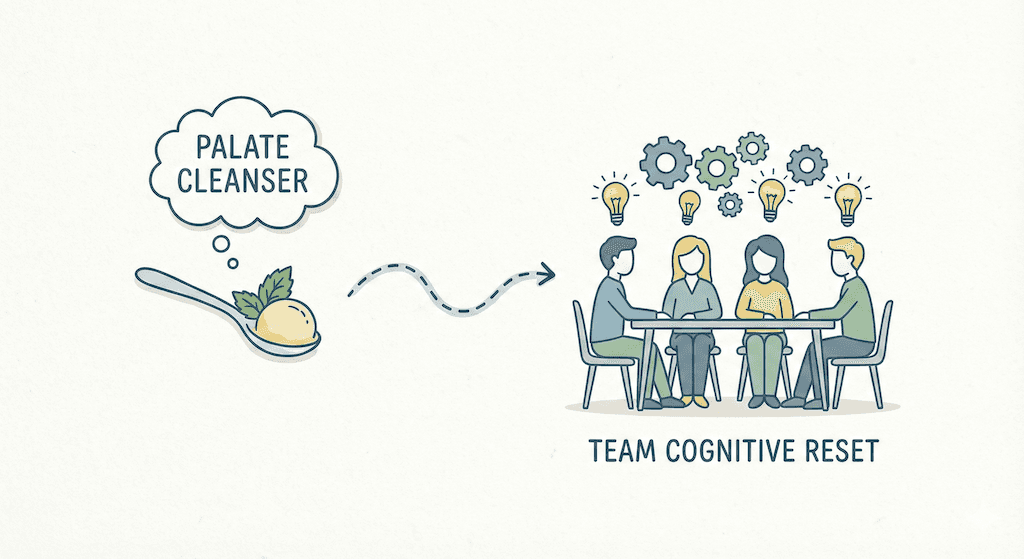
If you’ve ever been to a fancy restaurant, you know what a palate cleanser is. In between courses, the server will bring out a little dish of something, like sorbet, ginger, or apples. The palate cleanser is meant to neutralize previous flavors without introducing strong new ones, allowing for a fresh taste experience with each course.
Without a palate cleanser, your taste buds become overwhelmed. As the meal progresses your senses become progressively more dulled, until, by the final course, you are just going through the motions. At this point you may as well be eating fried spam.
In the agile world we have our own version of fried spam. That's the standup format where every member of the team waits their turn to dutifully recite what they did yesterday, what they plan to do today, yada yada. What is the point of this? Nothing dulls the senses more than forcing a group of people to gather and then wait for their turn to talk.
Here’s a fun thought experiment for you. After your next standup meeting, wait for 15 minutes and then try to summarize the content of the standup. Chances are you won’t be able to recall more than 15% of the information provided. Why is that? It’s not because there’s something wrong with your memory. It’s a trained response to being continually spammed with useless and irrelevant information.
The fact of the matter is, what someone else did yesterday is extraneous cognitive load that won’t help you be more effective today. It’s the professional equivalent of the grade school roll call: a worthless ritual that benefits no one.
The secret to running productive stand ups is to work your board right to left, top to bottom. In other words, the entire team should zoom in on the item at the upper right corner of your board first. Achieving collective understanding of the rightmost/topmost item should dominate the standup, even if it is the only thing you discuss.
To understand why, remember that in an agile board, work flows left to right. Depending on your board configuration, the rightmost/topmost item could be one of two things:
It’s the thing you just shipped to prod. In this case, your team should be focused on follow-through. What is uptake on the feature? Are any unexpected errors showing up in your monitors? Do prod logs indicate anything concerning? Do you need to rollback? Is it safe to rollout to a broader audience? This is the “ops” part of DevOps.
It represents potential value that you could deliver to customers with the smallest increment of effort. In this case your team should be focused on dragging the work across the finish line. Does the primary dev need help? Is anything blocking deployment? Is your instrumentation in order? What about feature flags? etc.
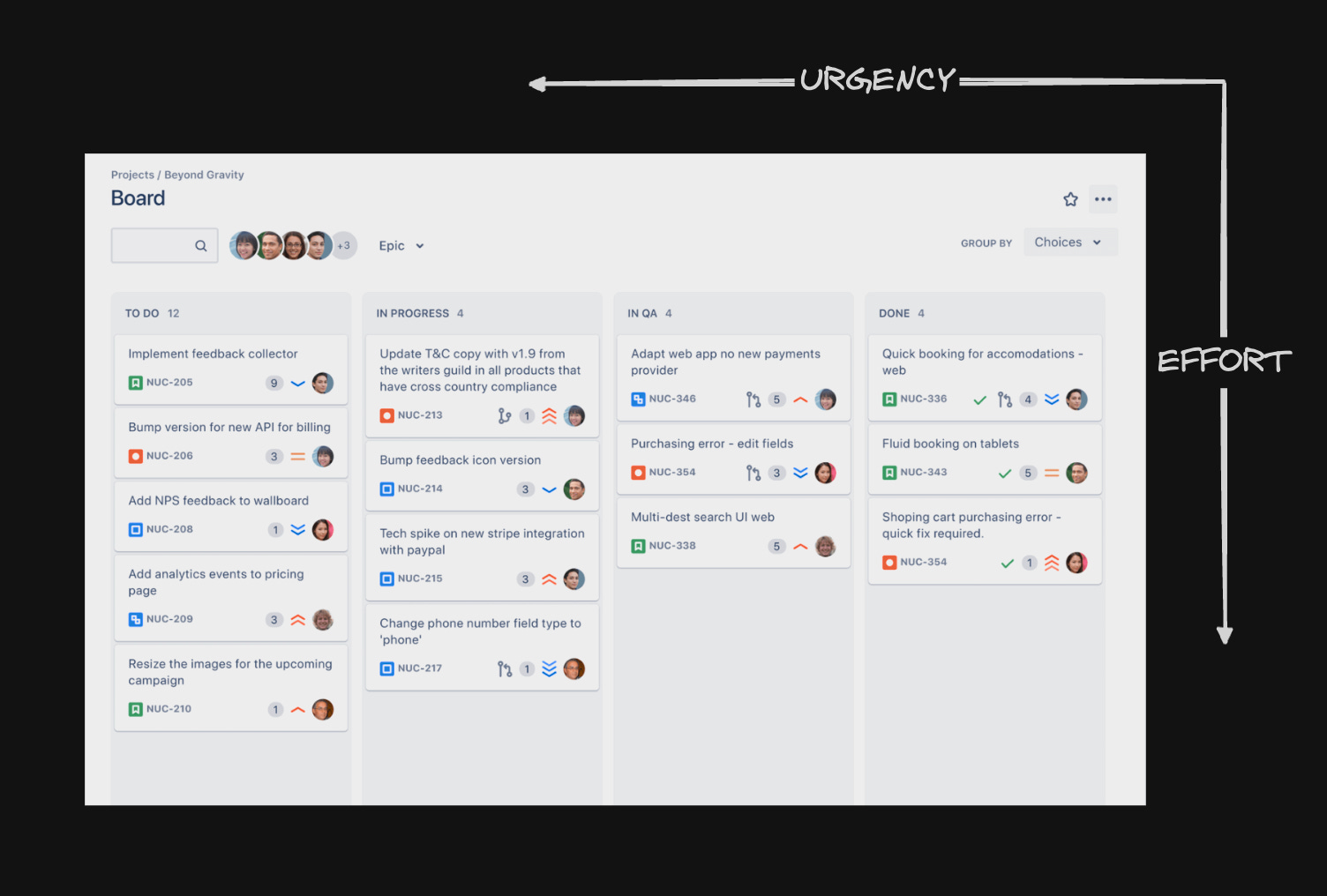
If you start to run stand ups this way, you will notice that the rightmost/topmost item dominates the standup, and you might not talk about anything else.
This is a good thing.
The point of stand up isn’t to spam minutiae to every member of the team. The point of stand up is to cleanse your team’s cognitive palate and re-focus your team on the only thing that matters: delivering quality to customers.