
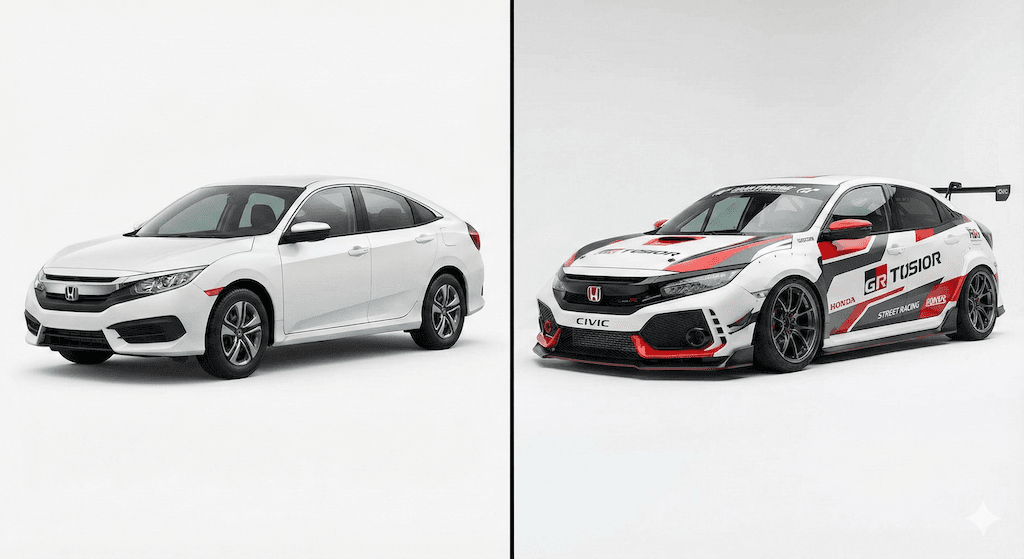
Last week I was stuck at a red light between two Honda Civics. On my right was a nondescript stock model. On my left was a street racer, that had been tricked out with after-market modifications.
The Fast/Furious movie franchise propelled street racers into the mainstream, but after-market mods have been a thing for a long time. In the 90’s I lived in Chicago and on weekend nights street racers would tear up Lakeshore Drive as far as the eye could see. At least half of the racers were Honda Civics.
Which raises an interesting question. How can the Honda Civic be both the mundane conveyance of suburban commuters, and the glittering chariot of an urban counterculture? The answer lies in the difference between a product and a platform.
The Iron Triangle of Platform Design
All successful platforms share three characteristics, which I call the Iron Triangle of platform design.
First, platforms must be open for extension but closed for modification. Computer nerds will recognize this as the “Open/Closed” principle which is a foundational concept in software design.
Second, platforms should require minimal tooling. A platform may be open for extension, but if you can’t extend the platform without expensive tooling, it may as well be closed.
Third, platforms should grow and evolve because of Other People’s Effort (OPE). Platform users must have an incentive to extend and promote the platform, without compensation from the platform owner.
Which brings us back to the Civic. The Civic captures 25% of compact car sales, not because it’s a great product, but because it’s a great platform that obeys the Iron Triangle of platform design. Let’s see how.
Open/Closed Principle
Have you ever wondered why street racers sound like a rabid raccoon trapped inside bag pipes? The answer is proprietary tech called VTEC, short for Variable Valve Timing & Lift Electronic Control. VTEC allows more air into the engine at high RPM’s while preserving efficiency at low RPM’s.
The important part of VTEC is the word “variable”. With factory settings, VTEC is optimized for everyday drivability and fuel efficiency. But VTEC engines can also accommodate higher performance when needed. In a VTEC system, solenoids, pressure switches, valves, and RPM’s are all variables that effect the performance profile of the vehicle.
VTEC means that the behavior of the Civic engine is open to extension. A Civic owner can, for instance, get dramatic performance improvement just by upgrading the VTEC pressure switch. However, you cannot substitute a non-VTEC pressure switch into a Civic engine, because the pressure switch has a specific role in a VTEC engine. In that sense the Civic is closed to modification.
This brings me to something inobvious about Honda’s underlying design philosophy. If you are designing a platform, your starting assumption is that the end users’ opinions matter, in which case, the Open/Closed Principle should be a strong influence on your platform design.
If you are designing an exclusive or luxury product, the starting assumption is that you know better than the end user. You don’t want an open platform, because after-market modifications could tarnish the brand. That’s why Ferrari and Bugatti are closed systems. If you extend a Ferrari you can be blacklisted by the manufacturer.
Minimal Tooling Required
How many mechanics does it take to change the headlight bulb in an American car?
For years I drove an older Buick which I bought from a friend who shipped out to Iraq. One winter a headlight bulb burned out so I went to AutoZone to buy a replacement. After poking around in the guts of the car I discovered that in order to replace the bulb, you actually need to remove the front skirt from the car. Removing the front skirt on an older Buick is basically impossible without a hydraulic lift. Once the car is in the air, you then need to wrestle with a complex array of screws, clips, and bolts. With the skirt unfastened, you need a second person to lift it out of the car frame, because if the skirt falls it can be damaged.
So what tools do you need to replace a bulb in a Honda Civic? None. With a Civic, if you pop the hood, you can easily reach the lamp housing and replace the bulb with your bare hands. This exemplifies the second principle of the Iron Triangle: successful platforms require minimal tooling. If you have a socket wrench set and a screwdriver, you can take a Civic apart right down to the chassis.
It should be noted that Hondas are so easy to work on by specific design. Honda wanted to lower production cost by making it easy to share components across different generations of the vehicle. They also wanted to make it easy to refresh or revamp the design for changing tastes and markets. By making the Civic easy to assemble on the production line, Honda also made the Civic easy to modify after market, which is one of the reasons the Civic has become such a successful platform.
Other People’s Effort (OPE)
The street racing subculture is not explicitly aided or subsidized by Honda in any way. All around the world, people work on their Civics for free, without thought or hope of recompense. This is remarkable, because when street racers drive tricked out Civics around, they’re basically driving a moving billboard for the Honda brand. Movies like the Fast/Furious franchise amplify the signal, bringing even more visibility and clout to the brand.
In other words, through very clever platform design, Honda has made itself the beneficiary of Other People’s Effort (OPE).
OPE is the “dark arts” of platform design, because it relies on human psychology, and our obsession with status. Status is why computer programmers contribute to open source projects on GitHub. Status is also why game designers create games for free on the Roblox platform. Finally, status is why car enthusiasts spend countless hours detailing and modifying their cars, right down to the specific pitch of the engine.
This is the third principle in the Iron Triangle of platform design. OPE happens when you make it easy for platform adopters to signal status within a knowledgeable community of interest. When that happens, your platform becomes an extension of its users’ collective ego. This is why platform adopters will fight to defend their platform. An attack on the platform is an attack on the community’s collective identity, which cannot be allowed.
Fashion vs Style
Geraldine Stutz, the retail pioneer who rescued the Henri Bendel brand, once said that “Fashion says ‘Me, too’, and style, ‘Only me’.” This quote is a précis of the difference between product and platform design. Great products exploit the psychology of “me too.” Great platforms exploit the psychology of “only me.”