
You've asked an AI coding assistant to implement a feature. It gives you code that works, but it feels like a compromise. Not quite as clean as you'd write it. Not as fast as it could be. Missing some error handling you know production needs.
Here's the problem: you asked one agent to balance competing concerns — maintainability, performance, robustness. And like a committee designing a horse, you got a camel.
What if instead of one compromised solution, you could generate three specialized implementations in parallel — each optimized for a single quality attribute — then merge the best techniques into something better than any single approach?
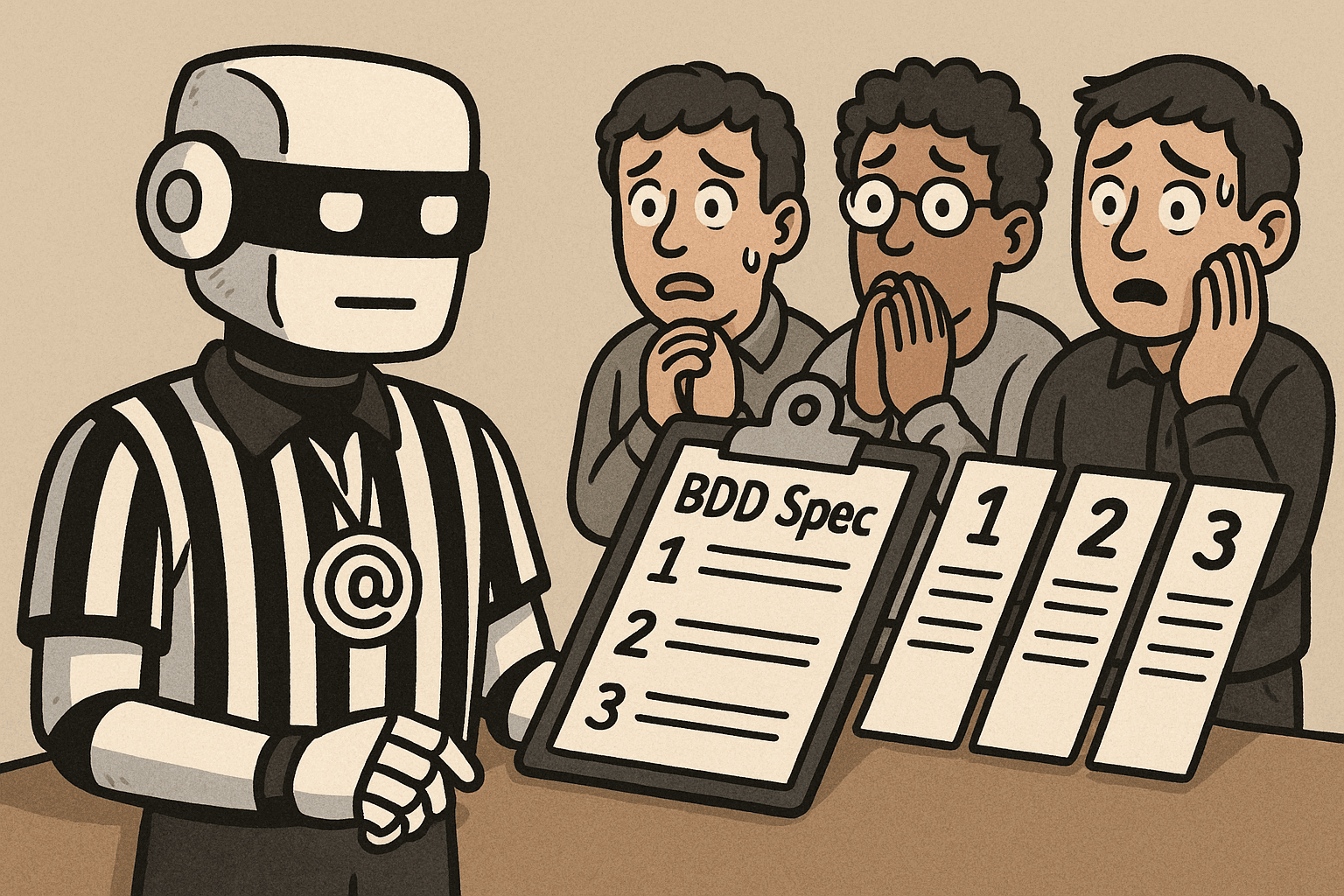
That's the Referee Pattern.
The AI Code Compromise
If you've been using AI coding assistants for a while, you've hit this wall.
You prompt: "Write me a calculator class with add, subtract, multiply, divide."
The AI gives you code. It works. Tests pass. But something feels off.
You wanted clean, maintainable code because this will live in your codebase for years. But the AI also tried to be fast, also tried to handle every edge case, also tried to add logging and thread safety. The result? A muddled middle ground that's not great at anything.
Your instinct here — and I did this for years — is to iterate on the prompt. "Make it more maintainable." "Actually, make it faster." "Add more error handling." Each time, the AI recalibrates the compromise, but you never escape the fundamental problem: you're asking one agent to balance competing quality attributes.
This is the iron triangle of code quality. You can optimize for maintainability — clean architecture, extensibility, SOLID principles. You can optimize for performance — speed, memory efficiency, algorithmic optimization. You can optimize for robustness — error handling, edge cases, defensive programming.
But when you ask one implementation to be all three, you get the worst of all worlds. Not maintainable enough to extend easily. Not fast enough for high-throughput. Not robust enough for production edge cases.
The Referee Pattern breaks this compromise.
Specialized Agents in Parallel
Here's the core insight: instead of asking one agent to balance everything, we run three specialized agents in parallel. Each agent gets the same specification, but a completely different focus.
Agent 1: Maintainability — optimize for long-term sustainability. Use clean architecture, design patterns, SOLID principles. Make it easy to understand and extend.
Agent 2: Performance — optimize for speed and efficiency. Minimize memory allocations, reduce abstractions, make it fast.
Agent 3: Robustness — optimize for production reliability. Comprehensive error handling, input validation, edge case coverage.
Each agent is told to ignore the other concerns. The maintainability agent doesn't worry about speed. The performance agent doesn't worry about extensibility. The robustness agent doesn't worry about code elegance.
What you get is three implementations that are radically different.
Our calculator example produces:
Maintainability agent: 255 lines across 4 files. Strategy pattern, custom exceptions, comprehensive docstrings.
Performance agent: 101 lines in 1 file. Direct methods, __slots__ for 40% memory reduction, zero abstraction overhead.
Robustness agent: 534 lines in 1 file. Exception hierarchy, input validation, thread safety, overflow detection.
All three implementations pass 100% of the same tests. They're functionally identical. But architecturally? Completely different.
The Technical Foundation: Git Worktrees
This is where git worktrees become essential. If you've never used them, they're basically a way to have multiple working directories for the same repository, each on a different branch.
Normal git workflow: you create a branch, make changes, commit, switch branches, make more changes. Context switching is slow and error-prone.
With worktrees: you create three separate directories, each on its own branch. All three exist simultaneously. You can run three separate Claude Code sessions, one in each worktree, and they never conflict.
Setup looks like this:
git worktree add -b maintainability-impl ../referee-pattern-maintainability
git worktree add -b performance-impl ../referee-pattern-performance
git worktree add -b robustness-impl ../referee-pattern-robustness
Three commands. Now you have three isolated environments. Each agent can work in parallel without stepping on the others.
What Each Agent Actually Produces
Let me show you real code from our calculator example.
Maintainability Agent
The maintainability agent gives us a multi-file architecture with clear separation of concerns.
# operations.py - Strategy pattern for extensibility
from abc import ABC, abstractmethod
class Operation(ABC):
    """Base class for calculator operations."""
    @abstractmethod
    def execute(self, a: float, b: float) -> float:
        pass

class DivideOperation(Operation):
    """Division with clear error handling."""
    def execute(self, a: float, b: float) -> float:
        if b == 0:
            raise DivisionByZeroError("Cannot divide by zero")
        return a / b
Operations are implemented using the Strategy pattern. Want to add a new operation? Create a new class, register it, done. No changes to the Calculator class needed. This is textbook Open/Closed Principle.
The code is verbose — 255 lines — but it's clean. Every class has a single responsibility. Docstrings everywhere. A junior developer could understand and extend this.
Trade-off: More files means more mental overhead navigating the codebase. The Strategy pattern adds a dictionary lookup on every operation. Not slow, but not free.
Performance Agent
The performance agent takes a completely different approach. Single file. Direct methods. No abstractions.
# calculator.py - Optimized for speed and memory
class Calculator:
    slots = ('_result',)  # 40% memory reduction

    def init(self):
        self._result = 0.0

    def divide(self, a: float, b: float) -> float:
        return a / b  # No abstraction overhead

    def add(self, a: float, b: float) -> float:
        return a + b
The key optimization here is __slots__. In Python, every object normally stores attributes in a dictionary, which costs memory. __slots__ tells Python to use a fixed array instead. 40% memory reduction in our benchmarks.
There's no Strategy pattern here. No separate files. Each operation is a direct method on the Calculator class. If you need to add a new operation, you modify the class. That violates Open/Closed, but it's 30% faster in our benchmarks.
Trade-off: Hard to extend. If your requirements are stable and performance matters, this is the right choice. If requirements change frequently, this will hurt.
Robustness Agent
The robustness agent produces 534 lines of code for a simple calculator. This might seem ridiculous — and for this trivial example, it is — but look at what you get.
# calculator.py - Production-grade defensive programming
import threading
import logging

class CalculatorError(Exception):
    """Base exception for calculator errors."""
    pass

class DivisionByZeroError(CalculatorError):
    pass

class InvalidInputError(CalculatorError):
    pass

class Calculator:
    def init(self):
        self._lock = threading.Lock()
        self._logger = logging.getLogger(__name__)

    def divide(self, a: float, b: float) -> float:
        self._validate_inputs(a, b)
        with self._lock:
            if b == 0:
                self._logger.error(f"Division by zero: {a} / {b}")
                raise DivisionByZeroError("Cannot divide by zero")
            result = a / b
            self._check_overflow(result)
            return result
Custom exception hierarchy. Every input validated with type checking and range checks. Thread safety with locks. Overflow detection. Comprehensive logging for debugging.
This is production-grade defensive programming. If you're building a calculator for financial systems where incorrect results could cost money, or medical devices where failures could harm people, this level of robustness makes sense.
Trade-off: Verbose. Slower. Over-engineered for most use cases. But if robustness is your primary concern, this agent gives you a blueprint for what "bulletproof" actually looks like in code.
The Merge: Combining Best Techniques
Here's where the pattern gets interesting. We have three implementations. All pass the tests. Now we merge.
But this isn't a traditional git merge where we try to combine all three files. This is strategic cherry-picking of techniques and approaches.
We start by evaluating. What's the line count? What's the memory usage? How fast is each approach? What's the cognitive complexity?
Then we ask: which techniques are compatible?
For example:
The Strategy pattern from maintainability gives us clean architecture
__slots__ from performance gives us memory efficiency
The exception hierarchy from robustness gives us clear error handling
These three techniques don't conflict. We can combine them.
The merged implementation takes the maintainability agent's Strategy pattern as the architectural base. We add __slots__ to every class from the performance agent. We include the exception hierarchy from the robustness agent, but skip the thread locks and extensive logging because this calculator doesn't need them.
Result: 302 lines. Modular and extensible like the maintainability version. Memory-efficient like the performance version. Error handling like the robustness version. Better than any single agent produced.
This is the mental model shift. You're not picking the "best" implementation. You're synthesizing a new implementation that combines orthogonal techniques.
Some techniques conflict — you can't have both a single-file monolith and a multi-file modular architecture. But many techniques are compatible — __slots__ works fine with Strategy pattern.
The merge is an act of architectural judgment. That's why it's not automated. You need to understand the trade-offs and make intentional choices.
When NOT to Use This Pattern
Before you run off and apply this pattern everywhere, let me save you some pain.
Simple, trivial tasks: If you're adding a getter method or renaming a variable, this is massive overkill. One agent, one implementation, done.
Time pressure: Running three agents takes longer than running one. If you're racing to ship, this adds overhead.
Obvious solutions: If there's one clearly correct approach, just implement it. Don't generate three versions of something when you already know the answer.
Spec Quality is the Multiplier
This pattern only works if your specification is clear and testable. Vague requirements like "make it better" will produce garbage from all three agents.
BDD scenarios work great:
Scenario: Divide two numbers
  Given I have a calculator
  When I divide 20 by 4
  Then the result should be 5.0
That's unambiguous. All three agents know exactly what to implement.
If your specs are fuzzy, fix that first. The Referee Pattern amplifies quality — both good specs and bad specs.
When to Add More Agents
Three agents is not a magic number. The pattern includes six agent definitions: maintainability, performance, robustness, readability, security, testing.
For a web API, you might run security, performance, and maintainability. For a data pipeline, you might run performance, robustness, and scalability.
Don't run all six at once. Merging six implementations is exponentially harder than merging three. Pick the three quality attributes that matter most for your context.
The Mental Model Shift
The Referee Pattern solves the AI code compromise problem. Instead of asking one agent to balance competing concerns, you orchestrate specialized agents in parallel. Each agent optimizes for one quality attribute. Then you merge the best techniques into a solution superior to any single approach.
Stop trying to craft the perfect prompt. Start treating code generation as an empirical process. Generate multiple approaches. Measure the differences. Make informed architectural decisions based on actual implementations, not theoretical debates.
You can clone the repository and try this in under a minute. The repo includes the full calculator example, all three implementations, merge strategies with rationale, and a complete worktree guide.
If you want to go deeper on reading and comparing codebases — which is fundamentally what the merge step requires — I cover this systematically in my course "How to Read Code."
The Referee Pattern is just one way to use AI more effectively. Once you stop thinking "better prompts" and start thinking "specialized orchestration," a whole new design space opens up.
Watch the Full Video
This video is an educational deep-dive walking through the Referee Pattern with live examples and visual demonstrations of each agent's output.
Want to Get Better at Reading Code?
The merge step in the Referee Pattern requires solid code reading skills. You need to quickly understand three different implementations, identify compatible techniques, and make architectural decisions.
If you want to level up your ability to read, analyze, and compare codebases, check out my course How to Read Code. It covers systematic approaches to code comprehension, pattern recognition, and architectural analysis.